Glaucoma Management

Home / Glaucoma (Kala Motia) Diagnosis & Care

Glaucoma (Kala Motia) Treatment in Jaipur

Glaucoma (commonly known in Hindi as 'Kala Motia' or 'Kala Pani') is a group of eye diseases that cause progressive, permanent damage to the optic nerve—the crucial cable connecting the eye to the brain. Often called the "silent thief of sight," glaucoma usually develops painlessly with gradual peripheral vision loss that patients rarely notice until significant irreversible damage has occurred.

At Pink City Eye Center and Santokba Durlabhji Memorial Hospital (SDMH), Senior Ophthalmologist Dr. Nitesh Bansal utilizes precision tonometry, gonioscopy, and optic nerve imaging to detect glaucoma early, control intraocular pressure (IOP), and protect long-term sight.
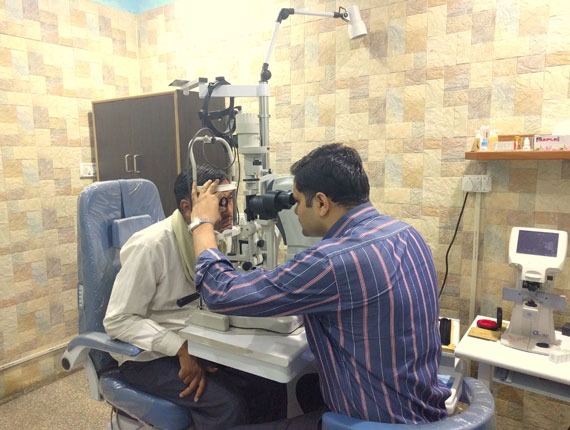
Dr. Nitesh Bansal Tonometry & Slit Lamp Glaucoma Checkup

Diagnostic Evaluation & Clinical Care

Comprehensive Glaucoma Investigations

Because glaucoma cannot be diagnosed by a simple eye checkup alone, a multi-faceted assessment is performed:

  • Applanation Tonometry: Precise measurement of intraocular pressure (IOP). Normal range is typically 10 to 21 mmHg.
  • Gonioscopy: Specialized examination of the drainage angle of the anterior chamber to differentiate between Open-Angle Glaucoma and Closed-Angle Glaucoma.
  • Optic Disc Biomicroscopy: Evaluating the cup-to-disc ratio and optic nerve head rim under high-magnification slit lamp microscopy.
  • Visual Field Perimetry: Mapping peripheral field sensitivity to detect subtle blind spots (scotomas) before central vision is compromised.
  • Pachymetry: Measuring central corneal thickness to adjust IOP readings accurately.

Treatment Modalities

While vision lost to glaucoma cannot be restored, further deterioration can be effectively halted through targeted pressure reduction:

  • Targeted Medical Therapy: Daily pressure-lowering eye drops (such as prostaglandin analogues, beta-blockers, and carbonic anhydrase inhibitors) to either decrease aqueous humor production or enhance drainage.
  • Nd:YAG Laser Peripheral Iridotomy (YAG PI): A quick, painless OPD laser procedure that creates a microscopic opening in the peripheral iris, relieving pupillary block and preventing acute angle-closure attacks.
  • Glaucoma Filtration Surgery (Trabeculectomy): Creating an alternative microsurgical drainage pathway when medications or laser therapy cannot sufficiently control pressure.

Who Should Get Screened Regularly?

  • Individuals aged 40 years and above.
  • Anyone with a direct family history of glaucoma.
  • Patients with high myopia (nearsightedness), diabetes, or chronic hypertension.
  • Individuals with a history of prolonged steroid eye drop or systemic steroid usage.

Book Eye Pressure Test

Schedule a comprehensive IOP checkup and optic nerve evaluation.


Medical Disclaimer: Glaucoma is a chronic eye condition that requires lifelong monitoring. Medications or laser treatments must never be discontinued without direct clinical re-evaluation by an eye specialist.

Where to Consult Dr. Nitesh Bansal

Regular OPD consultations, computerized eye testing, and advanced eye surgeries are conducted at two locations in Jaipur:

Hospital OPD & Advanced Surgeries

Santokba Durlabhji Memorial Hospital (SDMH)

Senior Consultant Eye Surgeon

Bhawani Singh Marg, near Rambagh Circle, Jaipur

Monday to Saturday: 10:00 AM – 4:00 PM

Sutureless MICS Cataract, LASIK, Contoura Vision & Glaucoma surgeries

Personal Clinic & Diagnostic OPD

Pink City Eye Center

Consultation & Computerized Testing

D-20, Eye Center, Near Vijay medicals, 80 Feet Road, Mahesh Nagar, Jaipur, Rajasthan 302015

Mon to Sat: 9:00–10:00 AM (Appt)  |  5:30–8:00 PM (Regular)

Sunday: 10:30 AM – 12:00 PM (Only by Appointment)

Computerized eye testing, spectacle removal consults & routine checkups